
Performance Solutions, Access & NCC Compliance Updates
This section shares practical insights, regulatory updates and commentary relating to performance solutions, access compliance and NCC interpretation. Drawing on real project experience, we publish guidance intended to assist builders, designers and building practitioners in navigating approvals, access requirements and performance-based compliance pathways.
Newsletter
16/08/2026 — AS 3959 Draft Revision: What the Proposed Bushfire Construction Changes Could Mean for Your Project
A draft revision to AS 3959 — Construction of Buildings in Bushfire-Prone Areas, the standard the NCC references for bushfire construction compliance — has been released for public comment. This is the more significant of the two recent AS 3959 revisions, and industry bodies including the HIA have flagged that it may change site assessment methods, Bushfire Attack Level (BAL) determinations, and the list of acceptable attachments and construction materials.
For most projects, AS 3959 compliance is handled through the Deemed-to-Satisfy pathway rather than a Performance Solution. But where a proposed design can’t practically meet the prescriptive BAL construction requirements, unusual attachments, non-standard materials, or site constraints that complicate a straightforward BAL assessment, a Performance Solution becomes the relevant pathway, and any shift in how BAL is determined or which materials are deemed acceptable has a direct flow-on effect on how that solution needs to be documented and justified.
Given the standard is still at draft stage, this isn’t yet something to redesign around. But for anyone with bushfire-prone site projects in the pipeline that won’t reach permit stage for some months, it’s worth keeping an eye on how the final revision lands, particularly around vent and ember-protection detailing and BAL-FZ documentation requirements, which have historically been areas where DAV Building Solutions has seen the most compliance friction on bushfire-affected sites.
For guidance on how these changes affect your project, contact DAV Building Solutions.
16/08/2026 — Livable Housing Design Standard: What Silver Level Actually Requires
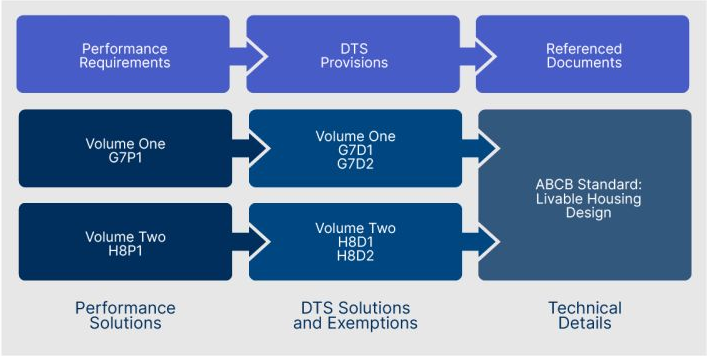
Livable housing design comes up in nearly every conversation about new residential Performance Solutions, but the actual Silver level requirements under NCC Part H8 are often misunderstood, usually assumed to be either much simpler or much more onerous than they actually are.
At its core, Silver level compliance under the Livable Housing Design Standard covers seven core elements: a step-free access path from the property boundary or parking area to a dwelling entrance, a step-free entrance door, a step-free path of travel from the entry to a functional space on the entry level, a toilet on the entry level with clear circulation space, a bathroom with a hobless shower recess, reinforced walls around the toilet, shower and bath capable of supporting future grab-rail installation, and a continuous handrail on any stairway with more than one riser.
Two of these consistently cause the most redesign friction. The reinforced-wall requirement is straightforward to design in from the outset but genuinely difficult and costly to retrofit once wall linings are installed, which makes it the most common point where a project needs a Performance Solution if it’s missed during design. The hobless shower requirement interacts closely with waterproofing and floor-level detailing, and on sites with limited slab-to-finished-floor tolerances, achieving a genuinely step-free shower recess without compromising falls-to-drain can itself require a Performance Solution.
Livable housing design applies to all new Class 1a and Class 2 dwellings, though the specific trigger conditions and any exemptions vary by state, so it’s worth confirming applicability against your project’s specific jurisdiction and building classification early, rather than assuming national uniformity.
DAV Building Solutions regularly prepares livable housing assessments and, where required, Performance Solutions addressing specific Silver level elements that can’t be met through standard detailing, most commonly reinforced wall zones and hobless shower waterproofing on constrained sites.
For guidance on how these changes affect your project, contact DAV Building Solutions.
31/08/2026 — Water Management and Condensation: A Growing Regulatory Focus
NCC 2025 strengthens water management provisions for commercial and apartment buildings and refines condensation management requirements across both Volume One (Part F8) and the Housing Provisions (Part 10.8). The timing lines up with a broader industry trend: as homes become better sealed and insulated for thermal performance, moisture that used to escape through gaps and draughts now has fewer places to go, and condensation-related mould issues have become more common, particularly in colder climates and poorly ventilated wet areas.
For Performance Solutions specifically, this raises the practical bar for waterproofing and vapour-management detailing wherever a Deemed-to-Satisfy solution can’t be followed exactly. Reviewers are increasingly likely to expect the interaction between insulation, vapour permeability and drainage to be explicitly addressed, not just the waterproofing membrane in isolation.
A recent DAV Building Solutions Performance Solution addressed weatherproofing and condensation management for a shipping container converted to a Class 1a dwelling, a building type with no direct Deemed-to-Satisfy pathway and particular vapour-management challenges given the steel envelope. The solution modelled the wall and roof buildup’s vapour behaviour and specified a ventilation and drainage strategy to manage interstitial condensation risk.
For guidance on how these changes affect your project, contact DAV Building Solutions.
31/07/2026 — Tasmania’s NCC Rollercoaster: A Lesson in Tracking Jurisdictional Timelines
Tasmania adopted NCC 2025 on 1 May 2026 alongside most other jurisdictions. Just over a month later, the Building Amendment Act 2026 took effect on 5 June 2026, reversing that decision — NCC 2022 was reinstated as the applicable Code in Tasmania and will remain so until 1 May 2027, at which point NCC 2025 is intended to apply.
For any practitioner working on Tasmanian projects, this is a useful reminder that a state’s published adoption date is a starting point for checking current status, not a fact to rely on indefinitely. A project that commenced design under NCC 2025 assumptions in May may now need to be reassessed against NCC 2022 provisions, depending on transitional arrangements and permit application dates.
DAV Building Solutions has completed several Performance Solutions for cool-room floor drainage in Tasmanian hospitality tenancy fitouts, where standard falls-to-drain detailing wasn’t achievable within existing slab levels. Given the code uncertainty outlined above, each of these projects has needed its Authority and Performance Requirement references checked against the applicable Code version at the time of the specific permit application.
For guidance on how these changes affect your project, contact DAV Building Solutions.
30/06/2026 — Accessibility and Amenity: The Quieter Changes in NCC 2025
Alongside the higher-profile structural and energy changes, NCC 2025 introduces several accessibility and amenity updates worth knowing about. A new voluntary Deemed-to-Satisfy pathway now allows some buildings to include separate, self-contained all-gender bathroom facilities as an alternative to traditional male/female sanitary compartment splits. NCC 2025 also increases required female toilet ratios and introduces mandatory sanitary product dispensers in new commercial and public buildings.
None of these changes affect the core livable housing provisions in NCC Part H8, which remain unchanged from NCC 2022 — both the 2022 and 2025 versions of the ABCB’s Livable Housing Design Standard remain valid compliance pathways for now.
Recent work has included accessibility and Class 3 acoustic compliance assessment for a supported disability accommodation (SDA) project, addressing sound transmission between sole-occupancy units alongside accessway and bathroom departures from standard DTS provisions. Projects in this space typically require close coordination between the Performance Solution and the funding body’s specialist design categories, which don’t always map neatly onto NCC classifications.
For guidance on how these changes affect your project, contact DAV Building Solutions.
31/05/2026 — NCC 2025 Has Landed — And Victoria Plays by Slightly Different Rules
NCC 2025 was formally published on 1 May 2026, but as always, publication and legal adoption are two different things. Victoria and Western Australia adopted on the publication date itself (WA refers to it as BCA 2025). South Australia has deferred adoption of Volumes One and Two until 1 May 2027, while adopting the Plumbing Code component immediately. The ACT commences NCC 2025 from 1 May 2026 but doesn’t make it mandatory until a year later, allowing a transition period. Practitioners working across state lines now need to track several live timelines at once rather than a single national date.
Victoria has also carved out a notable exception to last month’s Expert Judgement story: where nationally Expert Judgement has been removed as a stand-alone assessment method for structural and fire Performance Solutions, Victoria has retained the ability to use Expert Judgement for all Performance Requirements except the specific structural and fire provisions singled out nationally (B1P1 and H1P1). For Victorian practitioners, that’s a meaningfully different practical position to colleagues working under the unmodified national provisions.
A recent Victorian project involved a zero-threshold sliding door waterproofing solution for a multi-level residence, where the Deemed-to-Satisfy step-down requirement conflicted with the client’s accessibility and design brief. The Performance Solution demonstrated an alternative water management strategy at the threshold, coordinated with the window and door supplier’s tested detailing, exactly the kind of solution where Victoria’s retained assessment flexibility remains relevant.
For guidance on how these changes affect your project, contact DAV Building Solutions.
30/04/2026 — Performance Solutions Get Stricter: Expert Judgement Is On Its Way Out
One of the most significant technical changes in NCC 2025 has had comparatively little public attention: the removal of Expert Judgement as a stand-alone assessment method for structural and fire safety Performance Solutions. Under the outgoing approach, a suitably qualified expert’s professional opinion could, on its own, support a Performance Solution for these matters. NCC 2025 replaces that with quantified assessment, for structural elements, this means demonstrating a minimum reliability index using a defined calculation method, rather than relying on judgement alone.
The ABCB’s stated intent is to reduce subjectivity and produce more consistent, defensible outcomes across practitioners and jurisdictions. Professional judgement isn’t being removed from the process altogether, it still has a role within other assessment methods and when relying on Evidence of Suitability, but it can no longer stand alone as the entire basis for a structural or fire safety Performance Solution.
A recent DAV Building Solutions Performance Solution addressed below-ground retaining wall waterproofing for a two-dwelling development on a sloping site, where standard Deemed-to-Satisfy waterproofing detailing wasn’t achievable given the site’s fall and adjoining structures. The solution relied on documented product evidence, a defined drainage and membrane strategy, and coordination with the structural engineer, the kind of quantified, evidence-based approach that sits comfortably within the direction NCC 2025 is taking assessment methods more broadly.
For guidance on how these changes affect your project, contact DAV Building Solutions.
31/03/2026
29/07/2025
8/04/2024
NCC 2025 Victoria: Key Changes, Start Date & What You Need to Know
The National Construction Code (NCC) 2025 will officially commence in Victoria on 1 May 2026, introducing a range of regulatory changes that will impact designers, builders and consultants across the industry. The Australian Building Codes Board (ABCB) released a preview edition in February 2026 outlining key national updates; however, this version does not include Victorian-specific variations and additions, which will ultimately determine how the NCC is applied in practice. One of the most significant changes is the introduction of lead-free plumbing requirements, which will apply from the commencement date with no transition period. From 1 May 2026, plumbing products containing copper alloys and intended for use in drinking water must not exceed a weighted average lead content of 0.25%, requiring immediate compliance across all applicable installations.
Victoria will also reduce its state-based variations from 115 under NCC 2022 to 60 under NCC 2025, reflecting a broader shift toward national consistency and a reduction in regulatory complexity. Importantly, Victoria will retain the use of expert judgement as a valid assessment method for structural and fire safety performance solutions, despite its removal at a national level, maintaining flexibility for practitioners dealing with complex or non-standard designs. Additional updates include revisions to children’s services provisions to better align with the National Quality Framework and reduce regulatory burden, as well as the relocation of certain technical requirements from the Building Regulations 2018 and Plumbing Regulations 2018 into the NCC, improving accessibility and reducing fragmentation across multiple documents.
Collectively, these changes are intended to provide clearer and more consistent requirements, streamline compliance pathways and maintain high standards of safety and consumer protection. Given the immediate application of some provisions and the broader implications for design, documentation and approval processes, early familiarisation with NCC 2025 will be essential to avoid delays and ensure compliance.
NCC 2022 Amendment 2, which came into effect on July 29, 2025, aligns the National Construction Code (NCC) with the Disability (Access to Premises – Buildings) Standards 2010 (Premises Standards). The primary change is the adoption of AS 1428.1:2021, Design for access and mobility, replacing the 2009 edition. This amendment ensures consistency with the Access Code under the Premises Standards, which outlines accessibility requirements for public buildings.
A DDA / Access Performance Solution, in the context of Disability Discrimination Act (DDA) and the National Construction Code (NCC), is an alternative way to demonstrate compliance with accessibility standards when a Deemed-to-Satisfy (DTS) solution isn't feasible or practical. It involves using a tailored, performance-based approach to achieve the required accessibility outcomes. This allows for flexibility, innovation, and tailored design solutions that still meet the intent of the legislation.
Originally planned to take effect on 1 October 2023, The Victorian Government had declared an extended transitional period for the implementation of the NCC 2022's new living housing requirements. These requirements will now be active as of 1 May 2024.
The new living housing requirements will aim to help increase the stock of Australian housing that is adaptable and better able to meet the needs of older people and people with mobility limitations.
The livable housing design requirements apply to all new Class 1a and Class 2 buildings. If you are extending or renovating an existing home, you’ll need to follow your state/territory requirements for whether or not the works need to comply with the new NCC.
31/03/2026
29/07/2025
8/04/2024
NCC 2025 Victoria: Key Changes, Start Date & What You Need to Know
The National Construction Code (NCC) 2025 will officially commence in Victoria on 1 May 2026, introducing a range of regulatory changes that will impact designers, builders and consultants across the industry. The Australian Building Codes Board (ABCB) released a preview edition in February 2026 outlining key national updates; however, this version does not include Victorian-specific variations and additions, which will ultimately determine how the NCC is applied in practice. One of the most significant changes is the introduction of lead-free plumbing requirements, which will apply from the commencement date with no transition period. From 1 May 2026, plumbing products containing copper alloys and intended for use in drinking water must not exceed a weighted average lead content of 0.25%, requiring immediate compliance across all applicable installations.
Victoria will also reduce its state-based variations from 115 under NCC 2022 to 60 under NCC 2025, reflecting a broader shift toward national consistency and a reduction in regulatory complexity. Importantly, Victoria will retain the use of expert judgement as a valid assessment method for structural and fire safety performance solutions, despite its removal at a national level, maintaining flexibility for practitioners dealing with complex or non-standard designs. Additional updates include revisions to children’s services provisions to better align with the National Quality Framework and reduce regulatory burden, as well as the relocation of certain technical requirements from the Building Regulations 2018 and Plumbing Regulations 2018 into the NCC, improving accessibility and reducing fragmentation across multiple documents.
Collectively, these changes are intended to provide clearer and more consistent requirements, streamline compliance pathways and maintain high standards of safety and consumer protection. Given the immediate application of some provisions and the broader implications for design, documentation and approval processes, early familiarisation with NCC 2025 will be essential to avoid delays and ensure compliance.
NCC 2022 Amendment 2, which came into effect on July 29, 2025, aligns the National Construction Code (NCC) with the Disability (Access to Premises – Buildings) Standards 2010 (Premises Standards). The primary change is the adoption of AS 1428.1:2021, Design for access and mobility, replacing the 2009 edition. This amendment ensures consistency with the Access Code under the Premises Standards, which outlines accessibility requirements for public buildings.
A DDA / Access Performance Solution, in the context of Disability Discrimination Act (DDA) and the National Construction Code (NCC), is an alternative way to demonstrate compliance with accessibility standards when a Deemed-to-Satisfy (DTS) solution isn't feasible or practical. It involves using a tailored, performance-based approach to achieve the required accessibility outcomes. This allows for flexibility, innovation, and tailored design solutions that still meet the intent of the legislation.
Originally planned to take effect on 1 October 2023, The Victorian Government had declared an extended transitional period for the implementation of the NCC 2022's new living housing requirements. These requirements will now be active as of 1 May 2024.
The new living housing requirements will aim to help increase the stock of Australian housing that is adaptable and better able to meet the needs of older people and people with mobility limitations.
The livable housing design requirements apply to all new Class 1a and Class 2 buildings. If you are extending or renovating an existing home, you’ll need to follow your state/territory requirements for whether or not the works need to comply with the new NCC.